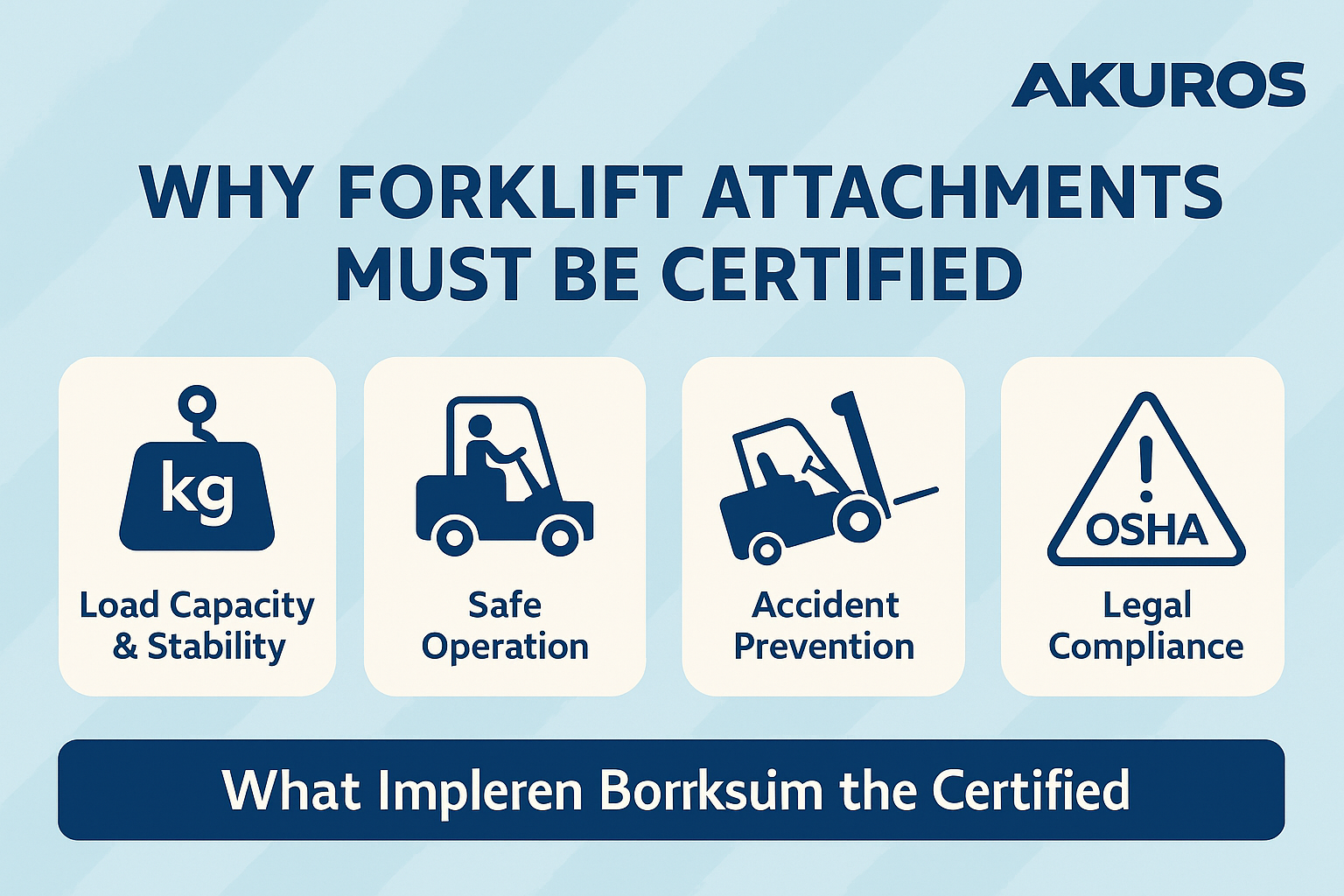
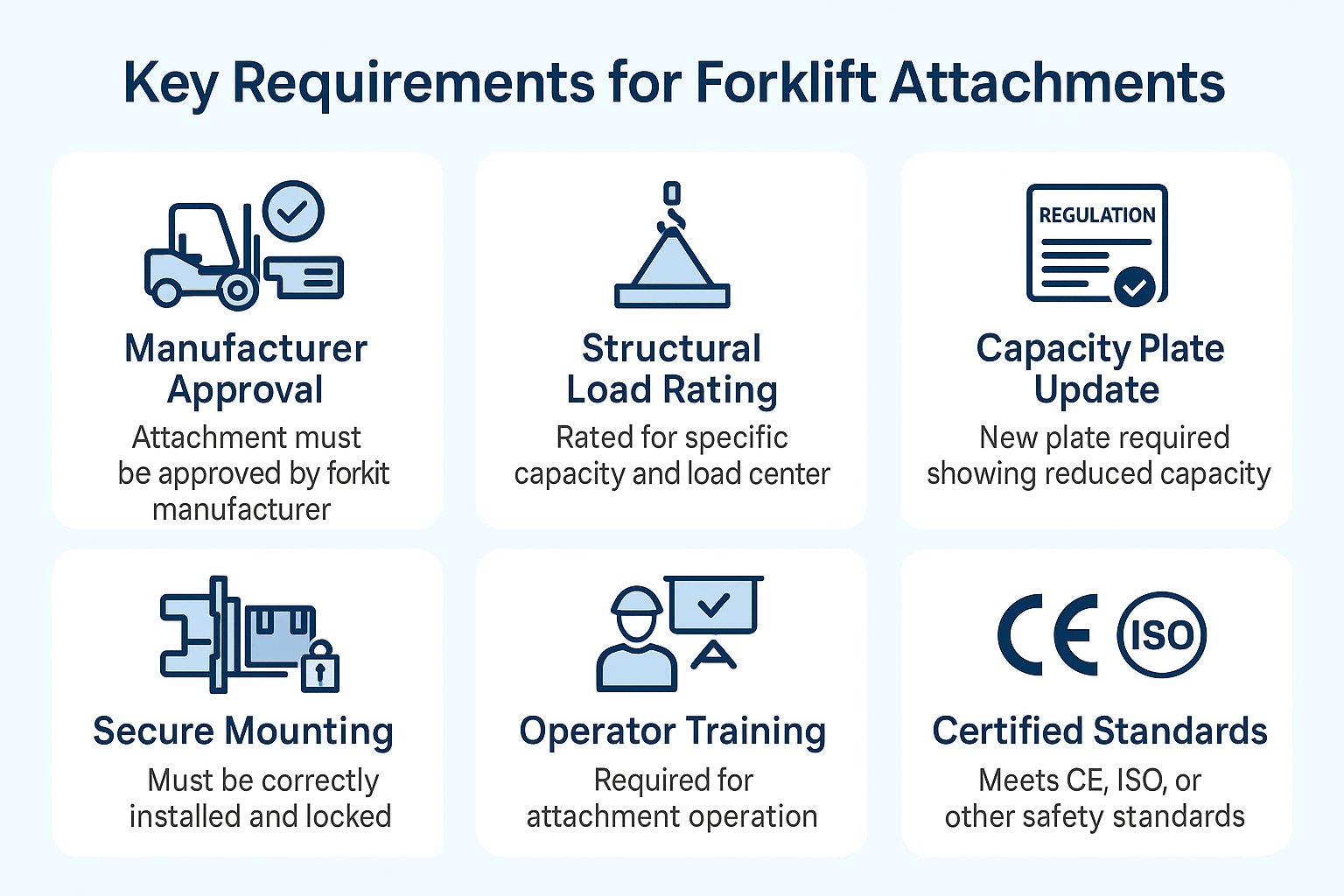
Forklift attachments unlock greater versatility and efficiency in material handling — from lifting paper rolls to handling multiple pallets at once. However, attachments are not “plug-and-play.” To use them safely and legally, they must meet specific technical, regulatory, and safety requirements.
This article outlines the key requirements for a forklift attachment, including design standards, compatibility, and compliance with OSHA and international regulations.
✅ 1. Manufacturer Compatibility & Approval
Before installing an attachment, it must be:
- ✅ Approved by the forklift manufacturer
- ✅ Designed to fit the specific forklift carriage class (e.g., Class II, III, IV)
- ✅ Compatible with the forklift’s hydraulic system and lifting capacity
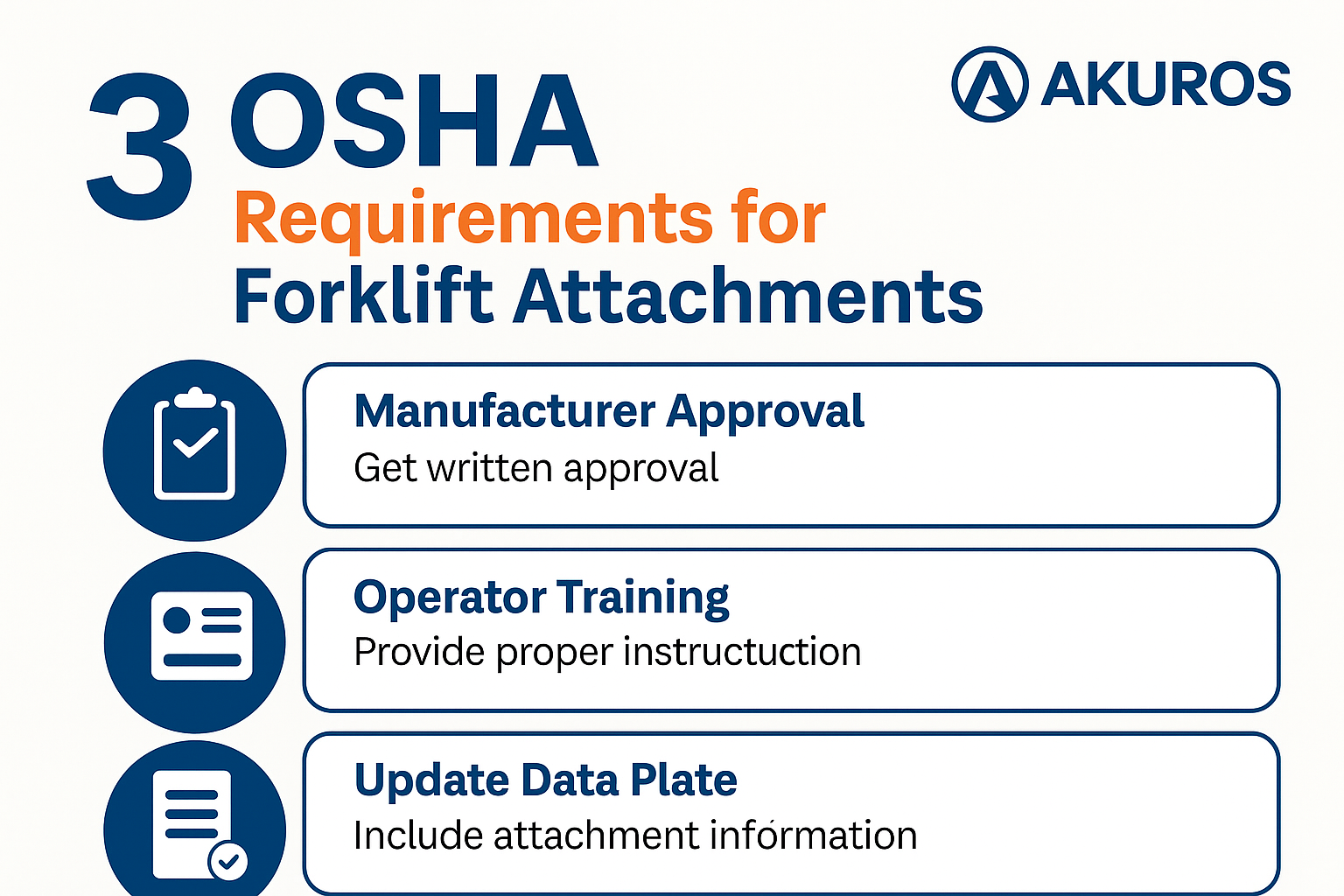
📌 According to OSHA 1910.178(a)(4), any modification, including attachments, must be approved in writing by the original manufacturer.
⚙️ 2. Structural Integrity & Load Rating
Attachments must be:
- Made of high-strength steel
- Properly rated for load capacity and center of gravity
- Tested for mechanical stress, wear resistance, and hydraulic reliability
Each attachment should have a visible nameplate indicating:
- Rated capacity
- Load center
- Serial number
- Attachment weight
🏷️ 3. Capacity Plate Update
Installing an attachment changes the forklift’s:
- Total lifting capacity
- Load center (moving the weight farther forward)
- Stability triangle
A new data plate (capacity plate) must be installed, clearly stating the forklift’s updated capacity with the attachment in place.
❗ Failing to update the data plate violates OSHA regulations and could result in serious safety risks or fines.
🛠️ 4. Installation & Safety Requirements
The attachment must be:
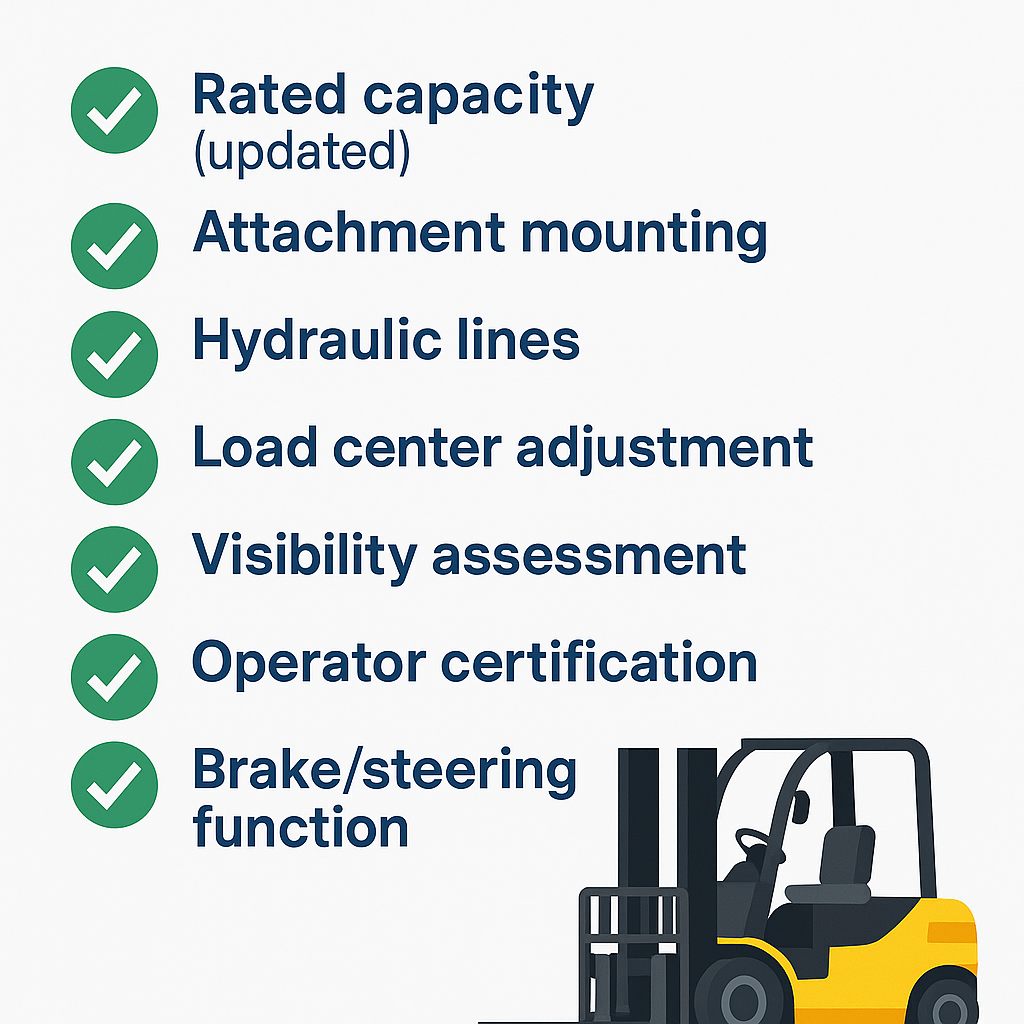
- Correctly mounted and locked onto the carriage
- Securely connected to the hydraulic lines, with no leaks
- Free of visible damage, cracks, or corrosion
Operators should:
- Test all functions (e.g., clamp, rotate, slide)
- Confirm smooth operation without unusual sounds
- Perform daily inspections
🎓 5. Operator Training
According to OSHA 1910.178(l), any operator using a forklift with attachments must receive task-specific training, including:
- Changes in load handling behavior
- Visibility differences
- Stopping and turning performance
- Inspection and operation of the specific attachment
Training must be documented and refreshed every 3 years.
🌍 6. International Safety Standards
Attachments used in global markets should meet international certification standards such as:
| Standard | Region | Purpose |
|---|---|---|
| CE | Europe/Global | Safety compliance for machinery |
| ISO 3691 | Global | Safety of industrial trucks |
| ISO 2328 | Global | Attachment mounting interface dimensions |
| UL | North America | Electrical safety for powered attachments |
📋 Summary: Forklift Attachment Requirements Checklist
| Requirement | Description |
|---|---|
| Manufacturer Approval | Required before installation |
| Structural Load Rating | Rated for specific capacity and load center |
| Capacity Plate Update | New data plate required showing reduced capacity |
| Secure Mounting & Hydraulic Check | Must be properly installed and leak-free |
| Operator Training | Required for safety and OSHA compliance |
| Certified Standards | CE, ISO, UL for legal and export compliance |
🧠 Conclusion
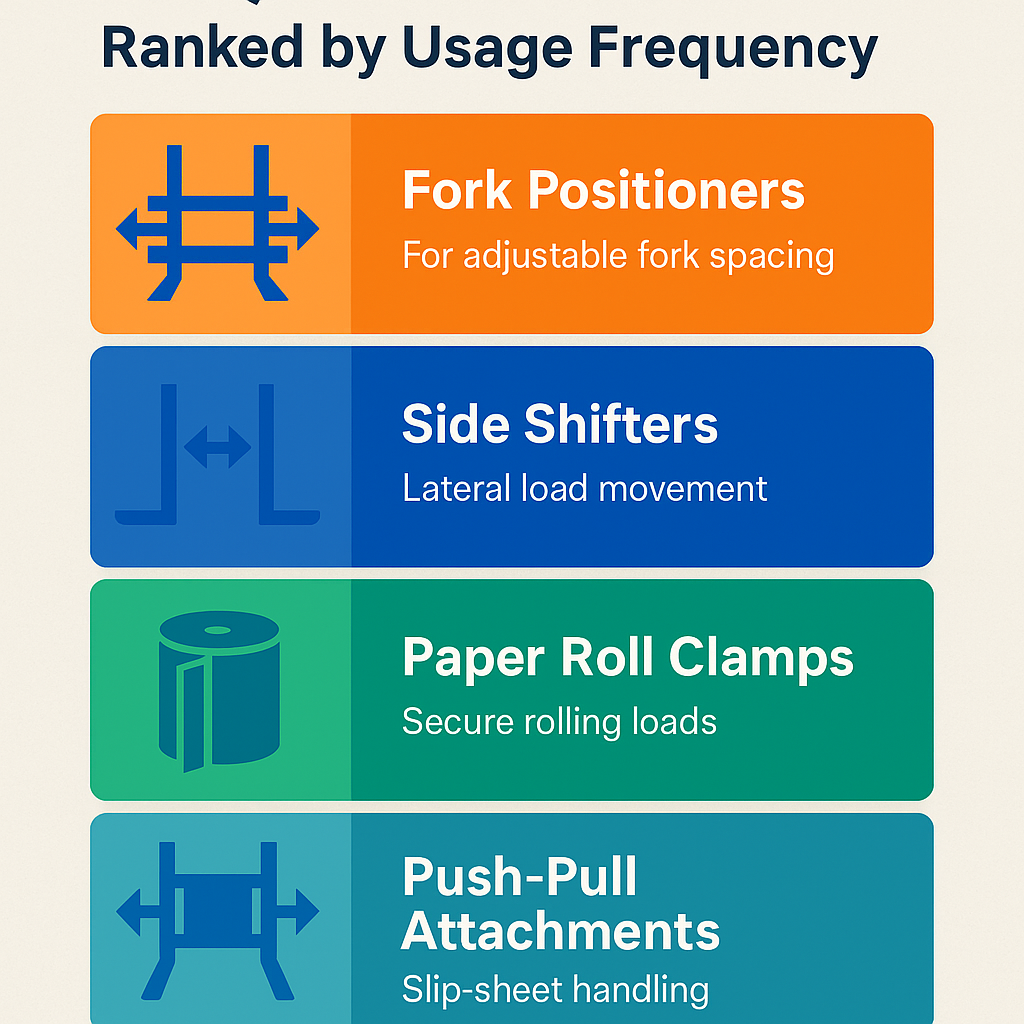
Using forklift attachments requires more than a mechanical fit — it demands compliance, safety checks, and operator awareness. Whether you’re using a clamp, fork positioner, or rotator, be sure the attachment:
- Is certified and manufacturer-approved
- Doesn’t exceed the forklift’s derated capacity
- Comes with updated labels and trained users
🚜 Need Certified Forklift Attachments?
At Akuros, we provide CE/ISO-certified forklift attachments engineered to meet safety, performance, and compatibility standards — with full OEM support and documentation.
📩 Contact us today to get the right attachment for your forklift.