When choosing a battery for industrial equipment, electric forklifts, or backup power systems, one of the most important questions is:
“Which lasts longer, lead acid or lithium?”
Understanding the lifespan difference between lead-acid and lithium-ion batteries can help you make better decisions for your operations, budget, and long-term efficiency.
In this article, we’ll break down lifespan, performance factors, and cost over time between these two battery types.
⏳ Battery Lifespan Comparison: Lithium vs. Lead Acid
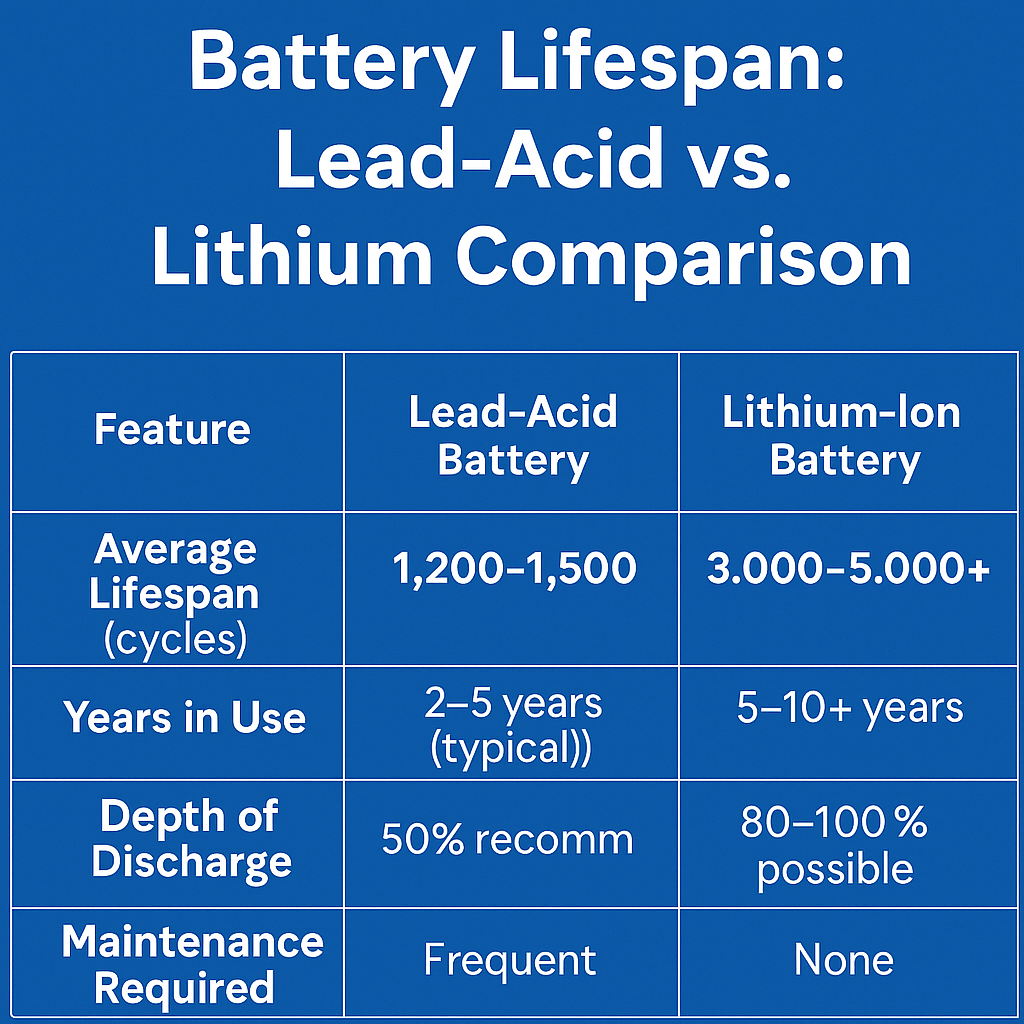
| Feature | Lead-Acid Battery | Lithium-Ion Battery |
|---|---|---|
| Average Lifespan (cycles) | 1,200–1,500 cycles | 3,000–5,000+ cycles |
| Years in Use | 2–5 years (typical) | 5–10+ years |
| Depth of Discharge | 50% recommended | 80–100% possible |
| Performance in Cold | Reduced significantly | Maintains higher efficiency |
| Maintenance Required | Frequent (watering, etc.) | None |
✅ Verdict: Lithium-ion batteries last up to 3–5 times longer than lead-acid batteries under similar usage conditions.
🔋 Why Lithium Batteries Last Longer
1. Deeper Discharge Tolerance
- Lead-acid batteries degrade quickly when discharged beyond 50%.
- Lithium-ion batteries handle deeper discharge (up to 90–100%) without damage.
2. Minimal Maintenance
- Lead-acid batteries require watering, cleaning, and equalizing.
- Lithium batteries are maintenance-free, reducing the risk of premature failure.
3. Stable Voltage Output
Lithium-ion batteries maintain consistent voltage throughout the discharge cycle, reducing stress on connected equipment and increasing efficiency.
4. Lower Self-Discharge Rate
Lithium batteries discharge at a much lower rate when idle, which helps prolong overall life—especially during storage or infrequent use.
💰 Long-Term Cost Advantage
Although lithium batteries cost more upfront, they offer better total cost of ownership (TCO):
| Cost Factor | Lead-Acid | Lithium-Ion |
|---|---|---|
| Initial Cost | Lower | Higher |
| Replacement Frequency | Every 2–4 years | Every 5–10 years |
| Maintenance Cost | Higher | Minimal/None |
| Downtime | More | Less |
✅ Over time, lithium batteries prove more economical due to longer lifespan, better efficiency, and less maintenance.
⚠️ Are There Situations Where Lead-Acid Is Better?
Yes, lead-acid batteries may be preferred when:
- Budget is very limited
- The application involves infrequent use
- Maintenance capacity is available
- Initial cost is a major decision factor
However, for high-frequency operations, multi-shift warehouses, and cold storage environments, lithium batteries are the superior choice.
🏁 Final Thoughts: Which Battery Lasts Longer?
Lithium-ion batteries last significantly longer than lead-acid batteries in nearly every application—from forklifts to backup power. With more charge cycles, deeper discharge capabilities, and zero maintenance, lithium batteries provide better long-term performance and value.
📞 Want to Upgrade to Long-Lasting Lithium Batteries?
Akuros offers high-performance lithium forklift batteries designed for durability, safety, and productivity.
👉 Contact us today to find the right battery for your application.